Growing vegetables indoors requires reliable light that mimics natural sunlight. The following five grow lights are highlighted for full-spectrum output, spectrum balance, energy efficiency, and adjustable features suited to vegetables from seedlings to mature plants. Use this guide to compare options and select the right setup for your indoor garden or grow tent.
| Product | Brand | Type | Highlights |
|---|---|---|---|
| SYEIORAOM Four Head Grow Light | SYEIORAOM | Full Spectrum LED | 360° gooseneck, red/white spectrum, adjustable distance |
| LEOTER Grow Light | LEOTER | Full Spectrum LED | 80 LEDs, timer, 10 dimmable levels, multiple spectral modes |
| Shyineyou Grow Lights | Shyineyou | Full Spectrum LED | 80 LEDs, memory timer, 3 modes, 9 brightness levels |
| VIPARSPECTRA P700 | VIPARSPECTRA | Full Spectrum LED | 11000 lumens, high PAR, fanless heat dissipation |
| Barrina T5 Grow Lights (4-Pack) | Barrina | T5 LED Strip | 5,000K white, high PPFD, individual switches |
SYEIORAOM Four Head Grow Light

The SYEIORAOM grow light uses a full-spectrum LED array with a red-white mix designed to support photosynthesis across plant growth stages. Its four adjustable heads and a flexible gooseneck enable precise lighting angles and distance control, helping vegetables like lettuce, herbs, and leafy greens to thrive indoors. The device emphasizes depth of coverage, enabling uniform light distribution over a plant canopy while remaining energy-efficient with modern LED technology.
LEOTER Grow Light
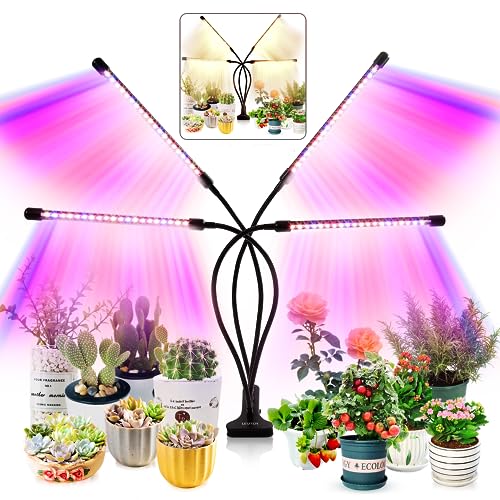
The LEOTER model combines a full-spectrum setup with a 660nm red and 460nm blue spectrum to support all growth stages, including germination, vegetative growth, and flowering. It features a circular memory timer that can automatically cycle on and off for 3, 9, or 12 hours, which is useful for weekdays work schedules and plant caretaking during trips. With 10 dimmable levels and multiple spectral modes, growers can tailor light intensity to plant needs and space constraints.
Shyineyou Grow Lights

Shyineyou provides an 80-LED full-spectrum setup with three lighting modes and nine brightness levels. The built-in 3/9/12-hour timer supports daily cycles, ensuring consistent lighting for seedlings through fruiting stages. The three-mode option—red/blue, red/white, or mixed—lets growers optimize growth by adjusting the ratio of photosynthetically active radiation, supporting vegetables from lettuce to peppers in compact indoor spaces.
VIPARSPECTRA P700 Grow Light

VIPARSPECTRA P700 combines a balanced full spectrum with efficient heat dissipation through large aluminum heatsinks and a fanless design. The result is a 70W light emitting up to 11,000 lumens, suitable for a 2×2 ft vegetative area. The design emphasizes both plant performance and quiet operation, making it a solid choice for beginners and seasoned indoor gardeners aiming to maximize seedling vigor and vegetative growth with lower energy use than traditional high-intensity discharge lamps.
Barrina T5 Grow Lights (4-Pack)

Barrina’s 1-foot T5 fixtures deliver a compact, high-PPFD light solution with 5000K white spectrum. The 4-pack setup provides dense coverage and simple plug-and-play operation, with individual switches for each fixture to tailor intensity across a breadth of small grow spaces. This option suits seedlings and leafy greens in a compact grow tent or shelf garden, offering efficient light distribution at a modest footprint.
Buying Guide: Key Purchase Considerations and Comparisons
Light spectrum and intensity: For vegetables, a full-spectrum or red/blue emphasis supports different growth stages. Look for a balanced mix around 6000–6500K for vegetative growth and supplementary red wavelengths around 660nm for flowering and fruiting. Measured PAR (photosynthetically active radiation) across the target area is a helpful proxy for performance.
Coverage and height adjustability: Check the recommended coverage area and adjustability of fixture height. Larger crops or taller plants benefit from higher light stand and wider beam angles, while compact herb gardens may require closer placement with adjustable goosenecks or tripod stands.
Controls and timing: Timers save effort and ensure consistency. Look for memory timers, multiple cycle options (3/9/12 hours), and dimming capabilities to tune intensity as plants mature. Independent fixture control is useful in multi-fixture setups.
Heat management: LED grow lights generate heat, but efficient heat sinks and quiet operation help avoid stressing plants and reducing room temperature. Fanless designs reduce noise but ensure adequate diffusion for longer sessions.
Installation and space: Consider mounting options (clip-on, hanging, or tripod) and the total footprint of the lights. For multi-tier racks or small rooms, compact, easy-to-install fixtures with adjustable stands are preferable.
Power efficiency and cost: LED-based systems deliver energy savings relative to older lamp technologies. Compare lumen output, PPFD values, and wattage to estimate electricity use over the growing cycle. More efficient models often yield better long-term value even if upfront costs are higher.
Durability and expandability: If you plan to scale your indoor garden, choose lights that can be combined easily (daisy-chaining or modular stacks) and have reliable build quality. Compatibility with other growing accessories can influence long-term satisfaction.
Warranty and support: A solid warranty and responsive customer support help protect your investment, especially for new growers experimenting with different light recipes.