Choosing the right grow light is essential for cannabis cultivation, especially in indoor environments. This guide highlights five high-performing LED options that support seedling onset through flowering, while balancing energy efficiency and heat management. Below is a quick overview of the selected products to help you compare features at a glance.
| Product | Brand | Strengths | Best For |
|---|---|---|---|
| VIPARSPECTRA P700 | VIPARSPECTRA | Seedling optimization, full spectrum, quiet heat dissipation | Compact tents |
| MARS HYDRO TS1000 | MARS HYDRO | High reflectivity hood, uniform coverage, energy efficiency | 2×2–3×3 ft tents |
| VIPARSPECTRA XS3000 Pro | VIPARSPECTRA | Lens-assisted focus, daisy-chain dimming, broad spectrum | Multi-light setups |
| BESTVA 2025 Upgrade DC1000 | BESTVA | Full spectrum near-sun quality, low heat, two growth modes | Budget-forward grows |
| LUYIMIN 1500W LED Grow Light | LUYIMIN | VEG/BLOOM modes, robust full spectrum, efficient coverage | 2.5×2.5 ft to 3×3 ft tents |
VIPARSPECTRA P700 Grow Light:

The VIPARSPECTRA P700 is designed for seedling and early vegetative stages, delivering 11,000 lumens through a balanced full spectrum that combines 660nm red with white wavelengths at 3000K and 5000K. Its heat management relies on a large aluminum heat sink and a fanless design, reducing noise and helping extend LED lifespan. With a wattage equivalent to a 150W HID, this fixture provides efficient energy use while supporting a compact 2×2 ft vegetative area. The P700’s diode layout emphasizes uniform light distribution to help uniform canopy development.
The unit’s focus on seedling vigor makes it a strong fit for starting cannabis plants in grow tents or small rooms. The lack of active cooling means less maintenance, but users should balance ambient temperatures to avoid heat buildup in warmer environments. For growers prioritizing quiet operation and space-saving form, the P700 offers reliable performance with a lower heat footprint than traditional HID systems.
Considerations: The compact size is ideal for small grow spaces, yet some users may want additional intensity as plants scale. The P700’s spectrum supports vegetative growth but may require supplementation for dense flowering. For beginners and intermediate growers, this light is a straightforward upgrade from basic shop lights while keeping operating costs modest.
MARS HYDRO TS1000 LED Grow Light:

The TS1000 from MARS HYDRO features a patented reflective hood designed to boost light utilization by up to 25%, with a 120-degree refraction angle that concentrates PAR where plants need it most. This fixture aims for even distribution, reducing hot spots across a 2.5×2.5 ft to 3×3 ft canopy. It uses a 150W draw while delivering high PAR/LUMEN output, positioning it as a strong replacement for a single-ended 250W HPS unit. The TS1000’s design emphasizes reliability and uniform coverage, which is essential for cannabis plants transitioning from seedling to flowering.
In terms of energy efficiency, the TS1000 provides solid yields with relatively low power consumption. Its compact form is suitable for mid-size tents, and it pairs well with multi-light arrangements where staggered lighting effects are beneficial. Users should verify compatibility with existing daisy-chain setups if expanding to multiple units for larger canopies.
Important notes: While the hood design improves light capture, some growers may prefer higher wattage fixtures for bloom stages. The TS1000 is best suited for home growers focusing on reliable, uniform light rather than extreme intensity. It is a good option for those upgrading from basic LED kits seeking better canopy penetration.
VIPARSPECTRA XS3000 Pro Grow Light:

The XS3000 Pro from VIPARSPECTRA emphasizes advanced optical lenses to concentrate light with minimal loss, supporting uniform PPFD across the canopy. This feature helps ensure consistent photosynthesis from the center to the edges of the plant, which is valuable for cannabis growth from seed to harvest. The product includes a dimming daisy-chain capability, allowing up to 20 units to be dimmed in sync, facilitating scalable setups for multiple tents or commercial grows. Its full spectrum includes 3000K and 5000K white, 660nm red, and IR 730nm wavelengths for a complete light recipe across growth stages.
With the XS3000 Pro, growers gain precise light control and the potential for expandability, which is beneficial for those running several connected fixtures or pursuing greenhouse-style configurations. The system’s dosing flexibility supports unique schedules, enabling tailored photoperiods for different strains or life stages. Noise-free operation and efficient design make it a practical choice for apartment setups and professional rooms alike.
Limitations: The higher upfront cost may be a consideration for hobbyists. The 20-light daisy-chain capability is powerful, but it requires careful planning to avoid over- or under-lighting in smaller tents. Proper mounting height and distance from canopy remain important to maximize the lens-based efficiency.
BESTVA 2025 Upgrade DC1000 LED Grow Light:

The BESTVA DC1000 is pitched as a cost-conscious yet capable full-spectrum grow light. It blends 3000K, 5000K, 460nm, and 660nm LEDs to approximate natural sunlight across vegetative and flowering stages. The unit’s design emphasizes two cultivation modes—VEG and BLOOM—offering a flexible dosing scheme that accommodates light cycle variations common in cannabis cultivation. While it claims a high-yield potential for compact spaces, it remains important to verify coverage in relation to tent dimensions to ensure full canopy exposure.
Energy efficiency stands out here, with lower wattage powering significant lumen output relative to HID equivalents. The overall spectrum supports healthy chlorophyll absorption and robust plant growth across life stages. For growers on a tighter budget, the DC1000 provides an approachable path to better yields without dramatic power draws, though some users may want to supplement with higher-intensity fixtures for dense flowering strains.
Practical notes: As with many budget-focused lights, performance can vary by unit and environment. Users should monitor heat within the tent and ensure adequate ventilation. The DC1000 pairs well with a scalable setup where multiple fixtures are used in combination for larger footprints.
LUYIMIN 1500W LED Grow Light:

The LUYIMIN unit offers three growth modes—VEG, BLOOM, or both—enabling a staged lighting approach that aligns with cannabis development from seedlings to harvest. The full-spectrum design relies on 3000K, 5000K, 465nm, 620nm LEDs, complemented by infrared 730nm to support flowering and deep canopy penetration. Advertised coverage reaches up to 3×3 ft, with a practical emphasis on 2.5×2.5 ft to 3×3 ft zones, making it suitable for mid-sized tents. The included dimming and diode layout aim to optimize light distribution and photosynthetic efficiency.
For growers seeking flexibility, the VEG/BLOOM combination can be a powerful tool, allowing growers to tailor light intensity and spectrum to different strains or growth stages. The unit’s daisy-chain capability supports scalable installations, helpful for expanding output across multiple tents or a single larger tent. Energy usage remains a consideration, as higher-wattage fixtures typically draw more power; ensure electrical capacity supports planned deployments.
100W Led Grow Light Bulb Full Spectrum:
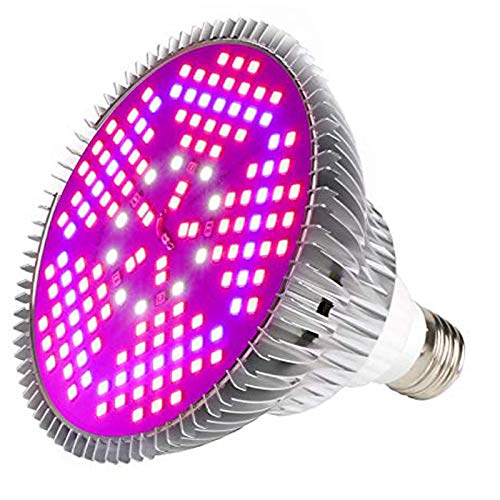
This plant light bulb fits standard E26/E27 sockets and delivers a full spectrum with 150 LEDs, including red, blue, white, and IR diodes. It’s a compact option designed to augment ambient lighting or provide supplemental spectrum for small plantings, seedling trays, or shelves. The device emphasizes heat dissipation through a metal aluminum radiator shell, helping to manage temperature in tight spaces. With a total luminous flux around 5,079 lumens, this bulb is best used as a supplementary light rather than a primary grow source.
Key advantages include ease of installation and low upfront cost, making it accessible for hobbyists or as an add-on to existing fixtures. For cannabis cultivation, this bulb is most effective in combination with a larger, higher-output system to ensure adequate canopy penetration and uniform coverage. It can fill in spectrum gaps or extend daylength in controlled photoperiod regimens.
Buying Guide: Critical Purchase Considerations
Light intensity and spectrum: Cannabis responds best to full-spectrum LEDs that cover blue (veg), red (flower), and infrared bands. Look for models offering adjustable spectrum or distinct VEG/BLOOM modes to align with growth stages. Consider PPFD maps or PAR outputs to compare true canopy penetration across fixtures.
Coverage area and vehicle for expansion: Match light footprint to your grow tent or room. A fixture rated for 2×2 ft may be insufficient for a 3×3 ft space unless you supplement with additional lights. Daisy-chain capabilities can simplify multi-light coordination in larger setups.
Heat management and noise: Passive cooling (large heat sinks) minimizes fan noise, but ensure room ventilation is adequate to prevent heat stress. For indoor cannabis, stable temperatures typically around 70–85°F (21–29°C) support steady growth; too much heat can reduce light efficiency and plant health.
Energy efficiency and cost: Compare wattage relative to output. LED fixtures with higher PPF efficiency deliver more light per watt, reducing electricity costs over time. While premium models may have higher upfront prices, long-term savings can justify the investment for larger grows.
Durability and warranty: Look for solid build quality, durable drivers, and a multi-year warranty. A dependable light reduces maintenance costs and plant downtime due to fixture failure.
Mounting and installation: Evaluate mounting options (rigs, tent frames, adjustable hanging kits) and ensure compatibility with existing hardware. Proper mounting height is crucial to avoid light burn or insufficient PAR at the canopy.
Grow-space goals: For beginners, start with a single, reliable full-spectrum light and scale up as needed. For more advanced setups, prioritize fixtures with lens optics and dimming capabilities to fine-tune intensity and coverage across diverse cannabis strains.
In sum, the five highlighted lights offer a spectrum of options—from compact, quiet units ideal for small tents to scalable systems suitable for multi-tent farms. Consider your space, budget, and cultivation goals when selecting a primary light source and any supplemental fixtures. This approach helps ensure robust growth from seedling through harvest while maintaining energy efficiency and manageable heat.